You couldn’t make this stuff up even if you tried.
The California Public Employees’ Retirement System for state employees lost 71% of its $468 million investment in a clean energy and technology private equity fund, state records show, but CalPERS won’t explain how.
To date, CalPERS relies on state statutes that shield numerous alternative investment documents from public scrutiny… a practice that could ultimately prove costly for California taxpayers and all parties connected to the fund.
These losses are a major problem for California taxpayers, who at least for now are the backstop for underfunded state pensions, but also for state employees who trust CalPERS to responsibly manage their retirement plans.
CalPERS says its pension benefits are only 79% funded, leaving the state, and its taxpayers, on the hook for the other 21%. According to a recent report from Reason Foundation, CalPERS’ pension shortfall is approximately $180 billion.
CalPERS’ overall returns for the 2024-2025 fiscal year were 11.6%. While its private equity returns were 14.3%, its public equity investments were 16.8%.
“Returns were similar … so why go through all the trouble — if you can get these kinds of returns on the public markets, why bother with all the complexities and the illiquidity involved in private equity?” asked Marc Joffe, a public finance expert and visiting fellow at the California Policy Center, in an interview with The Center Square regarding the performance of CalPERS’ private and public equity investments.
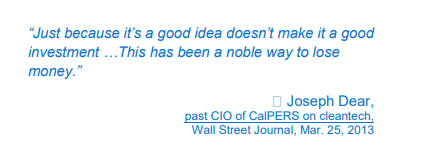
As it turns out, twelve years ago then CalPERS CIO, Joseph Dear, told the WSJ:
The absence of any forthcoming explanation suggests there’s no viable way to maintain the claim that clean energy technology can fully replace fossil fuels or nuclear power. It remains to be seen whether Californians will continue sacrificing their pension funds or tax dollars to the cause of climate change in the years ahead.
It’s regrettable that a more rigorous and transparent scientific evaluation of both climate science and technology wasn’t conducted before California employees’ funds were poured into the green energy abyss.
 Green Jihad