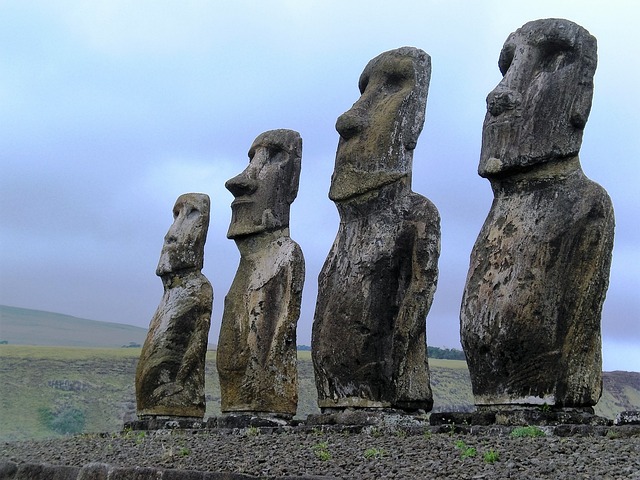
Shocking isn’t it?
Two recent studies have cast doubt on a popular theory that the ancient residents of Easter Island suffered a societal collapse because they overexploited their natural resources, an event often labelled one of history’s first “ecocides”.
Easter Island, located in the Pacific Ocean 3,700km from the coast of Chile, is best known for the enigmatic “moai” stone statues of humans carved by the Rapanui people.
A widespread theory popularised by historians, including US author Jared Diamond, claimed that the Rapanui deforested the small island, which is known to have once been covered in palm trees, to keep supporting the flourishing culture of its more than 15,000 inhabitants.
In his 2005 book Collapse, Diamond posits that the islanders’ efforts to build and transport the moai led to the deforestation of their land, stripping it of palms and other vegetation. He characterized Rapa Nui as the most evident example of a society that self-destructed through overexploitation of its resources.
However, as the AFP points out, none of Diamond’s conclusions turned out to be true. Despite Diamond rejecting drawing conclusions on on past populations using genetic history, scientists found no proof supporting Diamond’s hypothesis and their conclusions tell a very different story.
A study published in Nature this week found no evidence of a DNA bottleneck among the island’s Polynesian inhabitants prior to the arrival of Europeans in 1722. According to AFP, he research analyzed the genomes of 15 Rapa Nui individuals—both the name of the island and its people—who lived between 1670 and 1950, and found no indication of a sudden decline in genetic diversity.
The research supports the findings of another June study published in Science Advances, which used satellite imagery to map rock gardens on the island, a Chilean territory located 2,300 miles off the Pacific coast of South America. Rock gardening is an ancient farming method that involves incorporating stones into the soil to enhance crop yields by retaining nutrients and moisture.
In contrast, the AFP reports, the two new studies present a different narrative than Jared Diamond’s Malthusian-oriented ecocide claims. The manuscripts reveal that the population of Rapa Nui grew consistently from the initial Polynesian settlement, thought to be around the 10th century, to an estimated 4,000 residents by the time Europeans arrived approximately 800 years later. Currently, the island is home to only 3,000 Rapa Nui inhabitants.
The new findings suggest that the real story of Rapa Nui (known as Easter Island by colonial Europeans) is not one of self-inflicted population decline, but rather of cultural resilience. Compelling stories spread far more rapidly and endure longer than facts do. Human adaptability is far greater than human folly. Always has been and always will be.
 Green Jihad
Pay no attention to those exponential equations. Those are just theory!
LikeLike