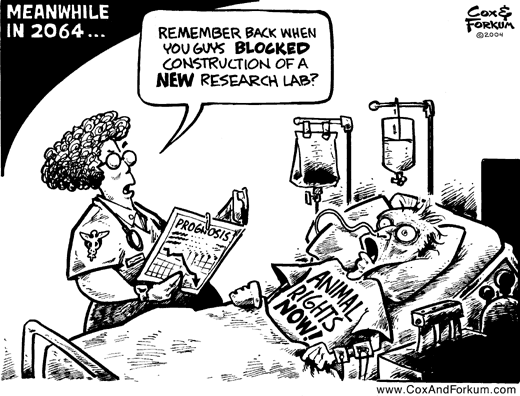
Real Clear Investigations published an interesting article recently essentially highlighting the accomplishments of White Coat Waste Project and other high profile MAGA Republicans who have scored wins restricting medical testing involving animals. On the surface the victories they’ve been raking up have been impressive but, simultaneously, concerning. For example, RCI states:
…MAGA luminaries Laura Loomer and Lara Trump – President Trump’s daughter-in-law and a board member of Big Dog Rescue – waged a highly visible pressure campaign on the company and the animal testing industry. At a time when partisan divisions continue to widen in the nation, one area of common ground seems to be animal welfare. …
…The movement has scored other wins recently. In 2022, the FDA Modernization Act 2.0 eliminated an agency animal testing mandate that had been in place for the better part of a century. White Coat Waste, a group that advocates against government-funded animal experimentation, was instrumental in defunding dog and cat testing at the Veterans Administration, as well as the departments of defense and agriculture.
But its not so much the successes of the so-called MAGA animal welfare movement that is being described, but that their efforts aren’t really successful at all and even the author admits the effort has huge hill to climb.
But animal testing remains a huge industry. U.S. scientists experiment on tens of millions of animals a year, according to an estimate by former University of California veterinarian Larry Carbone. The precise number is unknown, as most of them are fish, mice, and birds, which are exempt from animal welfare regulations and reporting requirements. About 62,000 dogs and cats are used in experiments annually, according to Humane World for Animals.
Naomi Charalambakis, a spokesperson at Americans for Medical Progress, an animal-testing advocacy group, says the practice remains necessary for scientific advancement and medical breakthroughs. She pointed to a new gene therapy for hearing loss, a personalized CRISPR gene therapy that saved the life of a baby, and a new injectable HIV-prevention drug as innovations that would have been impossible without animal testing. The practice was also used to develop the polio vaccine and the heart pacemaker. …
… The animal experimentation industry is almost entirely government-financed, mostly from the National Institutes of Health, which has close to a $50 billion a year budget. Between 40% and 50% of its grants go to experiments involving animal subjects, according to the NIH. …
If one reads the article carefully, the only victories are on the margins and, at best, this campaign’s efforts are superficial. It is understandable the people involved might have sprung up or organized in reaction to some very bad medical experiments involving animals conducted by the NIH when Dr. Anthony Fauci was in charge. But even animal rights groups aren’t getting everything they want.
… Although dogs are covered by the federal Animal Welfare Act, the rules allow for conditions activists consider inhumane. A dog’s cage is required to be only six inches taller and longer than the dog itself. If the cage is twice as big as the dog, then the animal is exempted from any exercise requirement, which means they may never be let out of their cage. Guidelines for minimizing pain for research dogs allow for model designs in which relief is deliberately withheld.
Even Donald Trump himself has not included all animals in his efforts to end animal testing at agencies, like the EPA, and may set a deadline to end vivisection by 2035 long after he has left office. Even other Trump officials, like NIH Director Jay Bhattacharya, have made similar claims about ending vivisection at their agencies but do not elaborate on the details of their efforts.
With this and animal rights groups defeat last month after their effort to steal beagles raised at Ridglan Farms failed, an end to vivisection in the near future is not a certainty overall.

